Apologies for the melodramatic title, but I have been musing of late on exactly when a project can be considered complete.
It is clear to any who know me, and those who read any of my blog, that I have a varied collection of figures. The majority of my collection has never seen the light of day in these entries, but hopefully will one day. I started painting "proper" figures as a teenager, but back then it was trying to get 1500pts of WRG Ancients done as quickly as possible for a game. I then did the same as I delved into other areas.
My largest collections are 2nd Punic War (large Roman and Carthaginian armies in 15mm for DBM), Orcs/ Goblins and Tomb Kings for Warhammer, Swiss-Burgundians in 28mm, Chaos Space Marines for WH40K and, of course, my Thirty Years' War.
Yet, I still have a "need" for Spanish allies for both sides for my Punic Wars armies, though I can field several hundred points of each.
I still have an Arachnarok spider, numerous goblins, squig riders and various other bits and pieces for my Orcs and chariots, Constructs, more infantry, etc for my Tomb Kings.
I have a wealth of extra pikemen, dismounted coustillers and other types for my Swiss and Burgundians.
My CSM remain devoid of Possessed, Chosen, the vehicles I still have to build and paint for them, a couple more dreadnoughts and so on.
And then there is my overall favourite, my Thirty Years' War. I have developed this collection far more than the others, yet still have probably four more infantry regiments, a couple of horse regiments, some dragoons and other bits awaiting my attention. I still want some more command, horse and artillery!!!
Is this just some sort of megalomania? I doubt the figures will all be in use together more than a couple of times a year. What else do I really need?
So when does it stop?
Hmmmm.
G
Monday, 29 October 2012

More big bangs
I have long wanted some more artillery for my Thirty Years' War collection, so took the opportunity to buy a few more bits at the Phalanx show back in June from those good fellows at 1st Corps/ Curtey's. I finally got round to painting them a couple of months back, ready for a game at Stafford Games on their "Games Day" (Sept 23rd). That is their only outing to date, but there will be more.
The 1st Corps figures are slightly smaller than my usual ones from likes of Renegade, Redoubt, Bicorne etc, but will mix if done so carefully.
G
 |
| Saker with mixed 1st Corps and Redoubt crew |
 |
| Light gun with 1st Corps crew |
 |
| The other light gun with more 1st Corps crew |
G
Saturday, 27 October 2012
Malifaux
Hi all,
My painting exploits seem to have slowed considerably as work and seasons take hold (terrible light, you know, even in a south-facing conservatory), but trying to get the odd game in......
.....and, talking of odd games, I present for your delight and delectation the alternate world that is "Malifaux".
Played my first ever game last Thursday night against a fellow newbie. What did I like?
And what did I not like (or like less)?
Will I be buying into this game?
With a rulebook and two "crews" under my belt already, you bet!!!
I shall revisit this and get some figures painted.
G
My painting exploits seem to have slowed considerably as work and seasons take hold (terrible light, you know, even in a south-facing conservatory), but trying to get the odd game in......
.....and, talking of odd games, I present for your delight and delectation the alternate world that is "Malifaux".
Played my first ever game last Thursday night against a fellow newbie. What did I like?
- The variety provided by the card-driven system, cards covering almost all actions within the game, allowing for 54 options (two jokers included).
- The simplicity of the basic rules, which play very smoothly, but have the capacity for a long time mastering....
- The figures, which are very good, though a tad pricey.
- The sheer variety of figures available, with numerous options within each of the five basic "crew" options.
- As a skirmish game, I do not need much to start.
- The choices you get to make throughout each turn of the game - play cards, use magic, enter combat, who to attack, what special rules to use, what combos are best suited, etc etc etc.
- Each game provides primary and secondary objectives for each player, so it is not just a killfest. Whilst I play points games, I greatly prefer scenario-driven ones and would choose these every time given the chance.
And what did I not like (or like less)?
- The simplicity of the basic rules is fine, but the numerous special rules each character carries look like a potential minefield. (I have taken to down-tooling my Warhammer and 40K armies as I can rarely remember special rules.....)
- The apparent lack of a creation system for my own characters. It seems to be use the "crews" provided or don't play.
- The aforementioned cost of the figures. Not exactly major East Mids manufacturer, but...
- I doubt I will ever play enough to master this game, or even get any good at it.
- Some "crews" appear to be much tougher than others, so the points costs are perhaps a bit askew.
- Each player has a "Crew". Warband maybe, or a squad, a posse, a group, a band, a family even, but not a "crew". There is not even a boat in the game from what I have seen. (Yeah, I know, call me "petty" if you like...)
Will I be buying into this game?
With a rulebook and two "crews" under my belt already, you bet!!!
I shall revisit this and get some figures painted.
G
Monday, 1 October 2012
More chiefs
As I posted a couple of days ago, I have not done much other than Frances for the past few weeks, but two of my projects of that time are presented here, Messrs Tilly and Saxe-Weimar.
As I try out a few more games of "Pike & Shotte" (I played my third on 23rd September), I was keen to get a few more brigadier options under my belt. For the uninitiated, regiments under those rules are placed into brigades or "battalia", each with its own commander, with a C-in-C overall.
I have had Oliver Cromwell (sorry, Saxe-Weimar) for a while, but bought Tilly at the Phalanx show in June (or possibly WMMMS in March......)
Both are now done, as you can see below.
G
As I try out a few more games of "Pike & Shotte" (I played my third on 23rd September), I was keen to get a few more brigadier options under my belt. For the uninitiated, regiments under those rules are placed into brigades or "battalia", each with its own commander, with a C-in-C overall.
I have had Oliver Cromwell (sorry, Saxe-Weimar) for a while, but bought Tilly at the Phalanx show in June (or possibly WMMMS in March......)
Both are now done, as you can see below.
G
 |
| Johann Tserclaes von Tilly, long time Imperialist commander. This is the Warlord Games figure. I love the religious symbolism built into him - the bible held aloft, the crucifix around his neck - every bit the champion of his faith until his death in 1632. |
 |
| To add to the symbolism, I tried my hand at a small, rural shrine to adorn his base. The statue of the Virgin is a Heroics & Ros 1870 Prussian artilleryman, padded out with a little green stuff. I would have mounted it higher on a bigger plinth, but I felt it detracted from the figure and its purpose. So, small rural, wayside shrine it is. |
 |
| This shot shows how tiny (too small probably) the finished article is when staged next to the Count. |
 |
| Oliver Cromwell. Hmm, I mean, Bernard of Saxe-Weimar. This is again a Warlord figure, the sergeant a Renegade figure with a Redoubt head swap. |
 |
| Facial close up. |
 |
| Final shot, the sergeant calming the horse a little - I see them both in the thick of the action under a "hot fyre". |
Saturday, 29 September 2012
Frances De (aka La Tour)
It has been probably six weeks since last I posted, so what have I been up to all this time???
Well, not that much really, but Jung-Tilly finally have their own musketeers and various other bits have been based and textured. I have also added a few artillery pieces and crews to my Thirty Years' War collection, along with a couple more generals - I will photograph and post soon.
One of my major focal points is the subject of this missive, however. Let me begin at the beginning....
I had a sofa.
It was a big, leather three-seater.
It was very comfortable as a seat, not to mention an occasional bed, but also found use by my smaller children as trampoline, bouncy castle, stage and various other play items.
It was looking sorry for itself, ailing more than a little, so had to go to the great sofa rest home in the sky.....
To get it to the hearse, it had to be dismantled, resulting in several wooden feet being removed, a spark of an idea forming in my mind as I "saved" four of these feet. They were all I had left of my lost, leathery love.........
The idea???
1) One foot to be given to each of my adult nephews.
2) The remit was to build a terrain piece using the wooden foot.
3) The finished terrain piece had then to feature in a scenario, either centrally as the scenario focus or just somewhere on the table.
4) I might sort out a small prize for the best....
Here is my take. Ladies and gentlemen, I give you Frances De....(or Henri De _ _ d'Auvergne if you prefer).
G


But what of the scenario?????
That would be giving too much away!
G
Well, not that much really, but Jung-Tilly finally have their own musketeers and various other bits have been based and textured. I have also added a few artillery pieces and crews to my Thirty Years' War collection, along with a couple more generals - I will photograph and post soon.
One of my major focal points is the subject of this missive, however. Let me begin at the beginning....
I had a sofa.
It was a big, leather three-seater.
It was very comfortable as a seat, not to mention an occasional bed, but also found use by my smaller children as trampoline, bouncy castle, stage and various other play items.
It was looking sorry for itself, ailing more than a little, so had to go to the great sofa rest home in the sky.....
To get it to the hearse, it had to be dismantled, resulting in several wooden feet being removed, a spark of an idea forming in my mind as I "saved" four of these feet. They were all I had left of my lost, leathery love.........
The idea???
1) One foot to be given to each of my adult nephews.
2) The remit was to build a terrain piece using the wooden foot.
3) The finished terrain piece had then to feature in a scenario, either centrally as the scenario focus or just somewhere on the table.
4) I might sort out a small prize for the best....
Here is my take. Ladies and gentlemen, I give you Frances De....(or Henri De _ _ d'Auvergne if you prefer).
G

 |
| Two shots of the source material, this second one showing the pronounced curve to two sides of the original foot. |
 |
| The front aspect, with steps formed from spare plastic 25x50mm bases. |

 |
| Guess where they throw the slops out... |
 |
| Close up - the foot was glued to a thin MDF base and padded out with rough slabs of polystyrene. The tower is a stout cardboard tube with another tube (from a gravy container) glued inside to give a base for the roof. The roof itself is a circle of corrugated card, the trapdoor a 20mm square plastic base with card edging. The crenellations are laminates of card, bent slightly and glued to the outer tube. Cork bark was then glued to the basic landform, loads of filler used for both landscape and stonework (scribed with a cocktail stick), and the whole thing painted with various matchpots. The doors and windows are painted directly onto the tube, having first of all built lintels, mullions and door jambs from card and matchsticks. The green "grass" effect is Basetex. The door knob is a 5mm piece of brass wire. |
 |
| The view up.... |
 |
| The view down... |
That would be giving too much away!
G
Wednesday, 8 August 2012
Mellow Yellow
Not really a fan of Donovan, but it seemed suitable title for my lyrical waxings about painting yellow. I always thought it would be the Stones and the Kinks for me if I had been born 10 years earlier....
Anyway, yellow.
One of those incredibly weak colours that struggles to cover any sort of undercoat, I have tried a few different techniques which I will briefly outline here for anyone interested. I do not like painting yellow or red, which shares the same problem for coverage, and used to go to great lengths to re-undercoat over my usual black to enable me to paint these colours, but that was all a bit laborious. Then, along came the GW Foundation range, which altered my painting significantly and these paints (and their recently released equivalents) form the basis for my present work.
1) Pale Yellow - black undercoat, Iyanden Sun basecoat, Gryphonne Sepia wash, then highlight with Iyanden Sun and finally with Bleached Bone. Gives a more washed out look, which I have used on my Swedish Yellow Regiment for the Thirty Years War. I will post some more close in pics to better illustrate, but there are some pics on the blog already from the 30 Years War/"Wargamer" show/ "Steinkirche" threads.
2) Bright Yellow - Bleached Bone basecoat washed with yellow ink. Gives a very vibrant yellow, but be careful when varnishing as the ink will run again when wetted. Used in the past when I have wanted a "special effect".
3) "Normal" Yellow (as in de Monthermer, Pennington, etc) - Iyanden Sun basecoat, washed with Gryphonne Sepia, then Iyanden Sun again and keep adding white and a bright yellow (I use GW Sunset Yellow) for extra highlights. I usually go for three successive highlights (Pennington, e.g.) but can lay off earlier for a deeper shade (e.g. de Monthermer).
This is probably all horrendously complex and I am keen to hear other views.
G
Anyway, yellow.
One of those incredibly weak colours that struggles to cover any sort of undercoat, I have tried a few different techniques which I will briefly outline here for anyone interested. I do not like painting yellow or red, which shares the same problem for coverage, and used to go to great lengths to re-undercoat over my usual black to enable me to paint these colours, but that was all a bit laborious. Then, along came the GW Foundation range, which altered my painting significantly and these paints (and their recently released equivalents) form the basis for my present work.
1) Pale Yellow - black undercoat, Iyanden Sun basecoat, Gryphonne Sepia wash, then highlight with Iyanden Sun and finally with Bleached Bone. Gives a more washed out look, which I have used on my Swedish Yellow Regiment for the Thirty Years War. I will post some more close in pics to better illustrate, but there are some pics on the blog already from the 30 Years War/"Wargamer" show/ "Steinkirche" threads.
2) Bright Yellow - Bleached Bone basecoat washed with yellow ink. Gives a very vibrant yellow, but be careful when varnishing as the ink will run again when wetted. Used in the past when I have wanted a "special effect".
3) "Normal" Yellow (as in de Monthermer, Pennington, etc) - Iyanden Sun basecoat, washed with Gryphonne Sepia, then Iyanden Sun again and keep adding white and a bright yellow (I use GW Sunset Yellow) for extra highlights. I usually go for three successive highlights (Pennington, e.g.) but can lay off earlier for a deeper shade (e.g. de Monthermer).
This is probably all horrendously complex and I am keen to hear other views.
G
Monday, 6 August 2012
Inspiration, Execution and Trials With Yellow
Picture the scene.
It is the summer of 1983 and a just turned 16 years old G is making his only ever trip to Warwick Castle with his older sister, her husband, their baby daughter and G's best mate. It is a lovely August day and the party are laid out on the green in the centre of the castle enjoying the warmth and fresh air. Young niece is busy crawling around eating daisies or something, as happy as can be.
Move on to the gift shop and the purchase of a certain tankard.
Striding forwards nearly 30 years, G is clearing his late mother's house and finds that tankard again. G is also slowly building up info on the Bannockburn era of Anglo-Scots warfare. The tankard stands out like a beacon in the dark and G decides he must paint its subject matter.
But it is yellow, a colour G does not like to paint, though has attempted on a few occasions, notably with his TYW Swedish Yellow Regiment and on the recently completed Sir William Pennington.
It had to be done.
I do not know whose retinue Ralph de Monthermer was part of, but he was there, at Bannockburn I mean. Graham Turner's painting in the Osprey Campaign Bannockburn book shows him alongside such worthies as Marmaduke de Thweng, Humphrey de Bohun, Earl of Hereford, and the late Gilbert de Clare, Earl of Gloucester, so I am going for the joint Gloucester/ Hereford battle, of which he is my first member.
I have several more exmples of heraldry from this particular battle within Edward's army, so he will be joined soon by de Bohun and co.
G
It is the summer of 1983 and a just turned 16 years old G is making his only ever trip to Warwick Castle with his older sister, her husband, their baby daughter and G's best mate. It is a lovely August day and the party are laid out on the green in the centre of the castle enjoying the warmth and fresh air. Young niece is busy crawling around eating daisies or something, as happy as can be.
Move on to the gift shop and the purchase of a certain tankard.
Striding forwards nearly 30 years, G is clearing his late mother's house and finds that tankard again. G is also slowly building up info on the Bannockburn era of Anglo-Scots warfare. The tankard stands out like a beacon in the dark and G decides he must paint its subject matter.
But it is yellow, a colour G does not like to paint, though has attempted on a few occasions, notably with his TYW Swedish Yellow Regiment and on the recently completed Sir William Pennington.
It had to be done.
I do not know whose retinue Ralph de Monthermer was part of, but he was there, at Bannockburn I mean. Graham Turner's painting in the Osprey Campaign Bannockburn book shows him alongside such worthies as Marmaduke de Thweng, Humphrey de Bohun, Earl of Hereford, and the late Gilbert de Clare, Earl of Gloucester, so I am going for the joint Gloucester/ Hereford battle, of which he is my first member.
I have several more exmples of heraldry from this particular battle within Edward's army, so he will be joined soon by de Bohun and co.
G
 |
| The tankard. Ralph de Monthermer, earl of Hertford (and later of Gloucester). There is some interesting blurb on the back about his life, how he was imprisoned by Edward I for secretly marrying his daughter, Joanna, etc. |
 |
| Slightly dark photo. His arms are Or, eagle displayed vert armed and langued gules. Why is green such an uncommonly used colour in heraldry? |
 |
| Slightly better photo (?) |
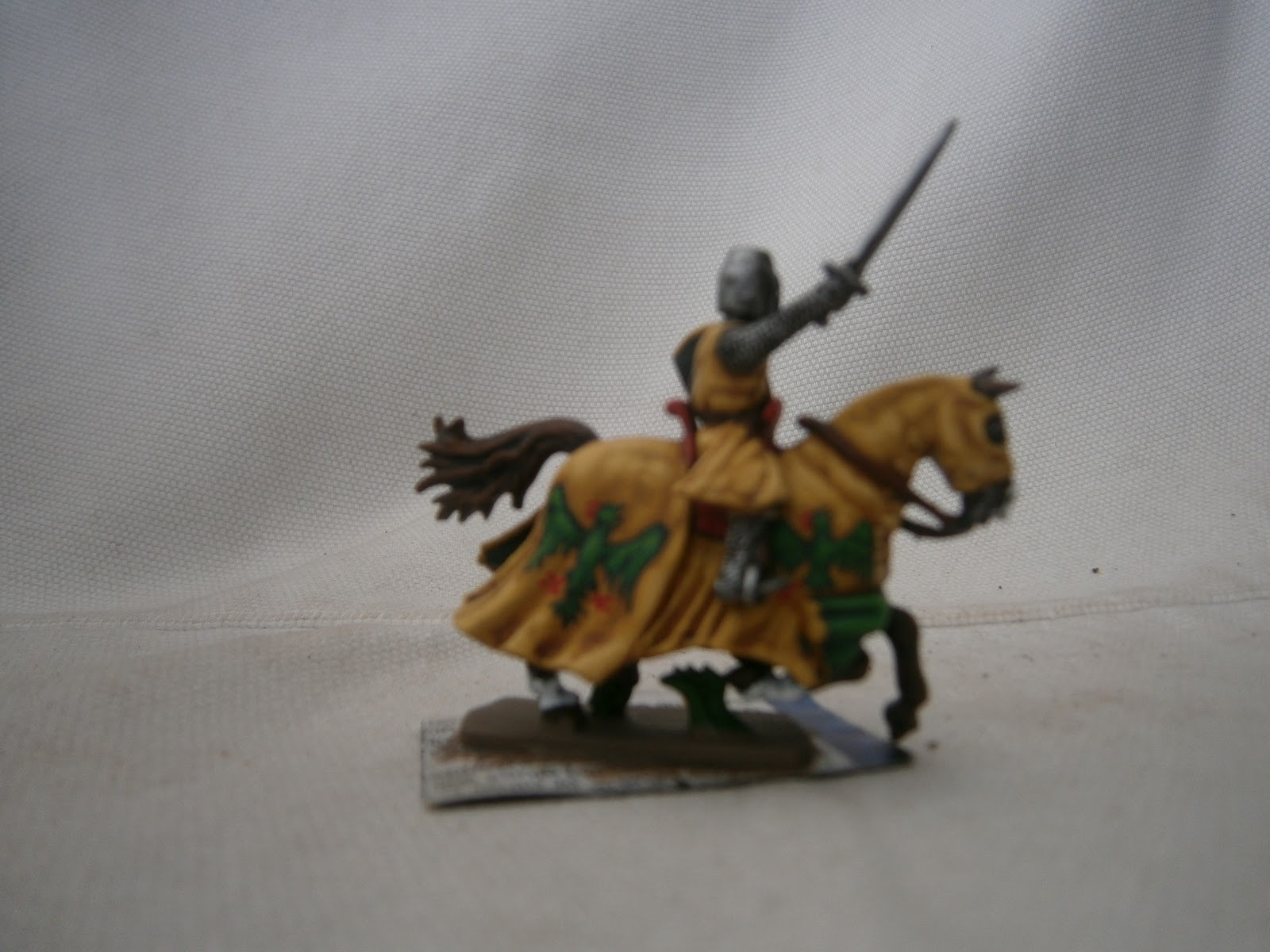 |
| The other side. Astute viewers may have noticed that I tried to copy the details of the tankard picture, not just the heraldry, by giving him a sword in his right hand, for example. Fireforge Games parts made up the figure again. |
 |
| The yellow here is a basecoat of GW Iyanden Darksun over a black undercoat. This was then washed with GW Gryphonne Sepia, then ID painted on again and highlighted with increasing amounts of GW Skull White and some old GW Sunburst Yellow. These colours all have equivalents in their latest range of paints. I have not highlighted this figure quite as strongly as I did with Pennington, as I wanted some variety within the same colour to show different wear and tear, inexact dye recipes, etc. |
Subscribe to:
Posts (Atom)